

As soon as I reached my 17th birthday, I learned to drive. This was mid-60s Britain, and stick shifts ruled the waves. We heard about those new-fangled automatic cars they had over in the USA, but automatics were still very rare in the UK.
Even today, pass your UK driving test in an automatic and your licence only covers automatics unless you later pass a test in a manual.
So my student driving was done with a stick shift. I learned in my mother’s late-50s Morris Minor, which she’d bought after previously driving my grandad’s 1940s Austin 7.
My grandad had bought the Austin as his first car in the mid-50s, when he was already close to retirement. He took his driving test a number of times but never managed to pass. The Austin sat in our back yard for years, used by my mother until she bought the Morris Minor, and was eventually sold for scrap.
That wasn’t an unusual fate for British cars in those days. The cool, damp weather and practically non-existent rust protection meant that many were lucky to see a decade before being consigned to the scrap heap.
But by 1968, I was ready for a car of my own.
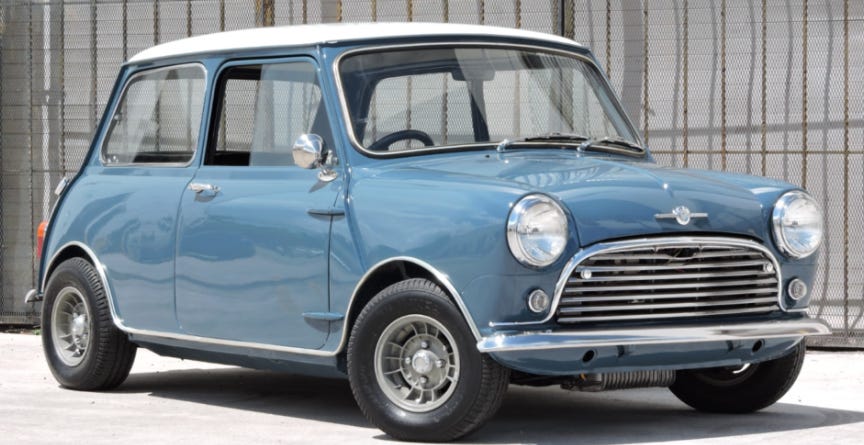
I’d travelled by train to university in Birmingham for my first two semesters, returning home to Deal for the Easter break in mid-April. My parents had a surprise waiting for me: a six-year-old Morris Mini, registration XAP47.
Newly repainted with a light blue body and a white roof, it was beautiful.
I was in love.
The original Minis had famously go-kart-like handling, but their performance was underwhelming, to say the least. XAP47 had an 848cc engine developing all of 34 horsepower and a top speed somewhere around 75 mph.
Not earth-shattering.
I quickly made the first of many modifications: reversing the front seat brackets to give myself an extra two inches of legroom—an essential fix for any taller Mini owner.
No matter how slow it was, the Mini became my faithful companion for the next five years.
And as for those performance limitations? No problem.
I had Speed King.
Speed King was a salesman in his 40s who always dressed in an old sports coat with patched sleeves and baggy corduroy trousers. He lived in the downstairs apartment of the house I rented with some student friends in Acocks Green, Birmingham.
He owned a souped-up Hillman Imp and, as we only had street parking, he was forever tinkering with it on the road outside the house.
“You can make that go faster, you know,” he told me, looking at my Mini when I proudly drove it up to the house for the first time.
I looked at him blankly. I didn’t have a clue how to work on a car.
“Well, you need a bigger carburetor, polish the cylinder head, upgrade the valves and install a straight-through exhaust,” he told me.
“To start with.”
So, with Speed King’s assistance -and the loan of his set of professional-grade auto tools - I became a weekend mechanic, trying to coax every additional fraction of horsepower out of that tiny engine.
How much faster did the car really go?
Probably not that much.
But every little helped, and the new exhaust sounded wonderful.
I couldn’t tell the story of my old Mini without mentioning the late Clive Trickey. Trickey wrote a number of books and manuals about tuning Minis in the 1960s. Although I’ve long since parted with them, I can still remember poring over their grease-stained pages, reading and rereading his words of wisdom before attempting the next improvement to XAP47.
This, of course, was long before YouTube. If you wanted to learn how to modify your car, you found a book, borrowed some tools and had a go.
And I certainly had plenty of opportunities to test the results.
Ah, the journeys I made in that Mini.
There was the regular trip between Deal and Birmingham, and later the far longer, eight-hour drive between Deal and Edinburgh.
Funnily enough, the Mini must have been deafening compared with a modern car, but my young ears didn’t seem to have a problem with it. There was no climate control, no navigation system and very little between me and the road. Yet I don’t remember thinking of it as uncomfortable or primitive.
It was simply my car.
I drove north into Scotland for the first time on a sunny Sunday afternoon in the autumn of 1970. After following the M6 north, I turned off near Moffat and suddenly found myself on what felt like a completely different journey.
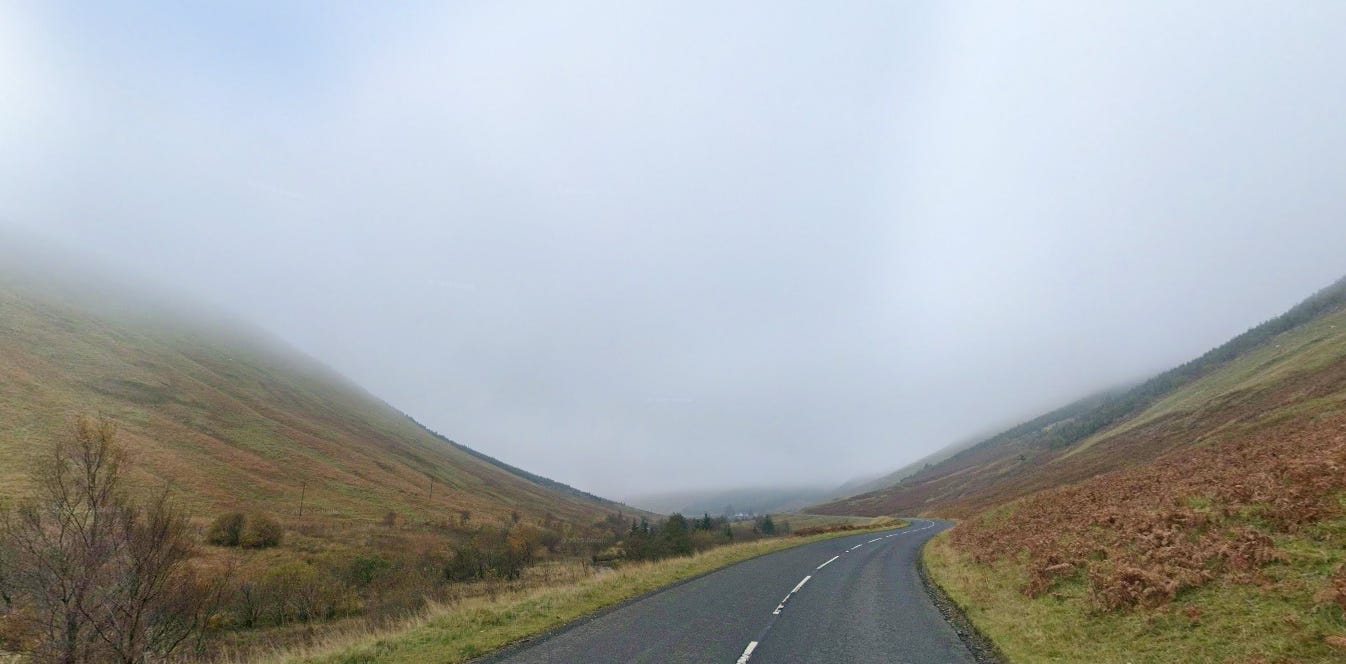
The road wound through the soaring scenery of the Southern Uplands, majestic hills rising on either side of my tiny Mini. There seemed to be no other cars around.
For a young man who had grown up in the relatively gentle landscape of southeast England, it was extraordinary.
Just me, XAP47 and the Scottish hills.
I was truly alone with nature.
Two years later, the Mini and I finally parted ways.
I’d been fighting a losing battle with rust for several years. Eventually, when my father offered to help me buy a brand-new Ford Escort, I realized it was time for XAP47 and me to say goodbye.
The Escort was newer, faster, quieter and unquestionably a better car.
But it wasn’t my first car.
More than half a century passed.
There were plenty of other cars along the way. I left Edinburgh, eventually left Britain, moved to America and lived a life that the 18-year-old driving XAP47 around Birmingham could hardly have imagined.
A few years ago, my wife and I moved to the Charlotte, North Carolina area and downsized to a house with a smaller two-car garage. We decided we could manage with one car and sold our second.
Eventually, though, we began to miss the flexibility of having two.
I wanted something small enough to fit comfortably beside our other car. I started looking at the possibilities, and then the answer suddenly seemed obvious.
A Mini.
So, 58 years after my parents surprised me with XAP47, I found myself walking into a Mini dealership and doing it all over again.
Except, of course, I wasn’t.
Today’s Mini is almost comically different from the car I owned in 1968.
My 1962 Mini didn’t even have seat belts. The new one surrounds me with airbags, cameras, sensors and electronic safety systems. XAP47 produced 34 horsepower. My new Mini Cooper S has roughly six times as much power and can theoretically approach 150 mph—a claim I have absolutely no intention of verifying.
But the biggest difference is what happens when I sit behind the wheel.
I sometimes wonder what the 18-year-old me would make of it.
Instead of the wonderfully basic dashboard I remember from XAP47, there’s a huge circular display in the center of the car controlling everything from navigation and climate to entertainment and driving modes.
And then there’s Go-Kart Mode.
Yes, really.
Somebody at Mini apparently decided that a car whose original claim to fame was its go-kart-like handling now needed an electronic setting actually called “Go-Kart Mode.”
Select it and the car changes its responses to make everything feel sharper and more aggressive. The steering becomes heavier, the throttle more responsive and the car even adds a more aggressive engine sound to the experience.
What would Speed King have made of that?
I suspect he’d have approved.
My new Mini is so technologically superior to XAP47 that, viewed from 1968, it might as well have come from another planet.
It’s faster.
It’s safer.
It’s quieter.
It’s more comfortable.
It’s better made.
And it doesn’t appear to be dissolving from rust before my eyes.
My new Mini is faster, safer, quieter and better made than XAP47 in every conceivable way.
But if someone pulled up outside my house tomorrow in a little light-blue 1962 Morris Mini with a white roof and registration XAP47, and offered me the keys in exchange for my new one, I’d make the swap in a heartbeat.
Not because XAP47 was a better car. It wasn’t.
But for a moment, I might just be eighteen again.